
Build an AI Law Course Your Way — and Share It in One Link
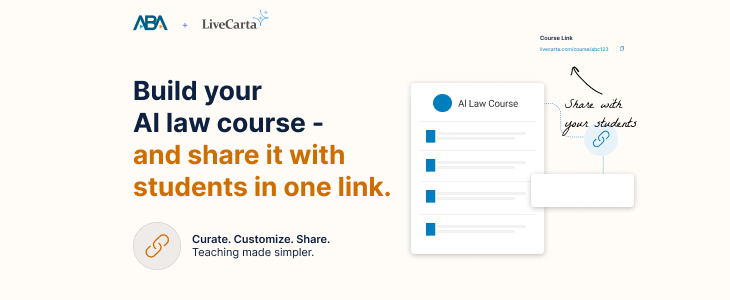
Your students are already encountering AI in legal research, writing, client work, and everyday study. The harder question is what to teach them — and how to turn a growing body of AI-related material into a course that actually fits your syllabus.
The American Bar Association has published books covering AI ethics, legal risks, governance, regulation, due diligence, and the changing practice of law. LiveCarta lets you pull the chapters you need from those titles, organize them into one course, and add your own teaching context.
You can start with a topic and build from there. Or start with a chapter you already know belongs on the syllabus.
Either way, the process looks like this.
Start with the questions your students need to understand
An AI law course can go in a lot of directions.
Maybe the first question is simply: What is AI actually changing in legal practice?
Then come the harder ones:
-
What does professional responsibility look like when lawyers use AI?
-
Who is responsible when an AI-assisted workflow goes wrong?
-
What should a firm consider before adopting an AI vendor?
-
How should lawyers approach client data and confidentiality?
-
What AI policies should law firms have?
-
How are regulators approaching these technologies?
-
What does an AI-literate lawyer actually need to know?
You don't need one book to answer all of these questions.
You can build the course around the chapters that do.
Five ABA titles give you different ways into the subject
The AI-Enabled Law Firm can provide the backbone for a broader course, with chapters covering the AI revolution in legal services, professional responsibility, legal and compliance risks, training, and AI governance.
A Lawyer's Guide to AI: Ten Essential Concepts works well at the beginning of a course, particularly when students have different levels of AI experience. Its shorter chapters can establish a common vocabulary before the class moves into more complex legal questions.
Think Like a Lawyer About Artificial Intelligence approaches AI through established legal reasoning frameworks. One or two chapters can add a legal-analysis perspective to a course without making the entire curriculum about technology.
Artificial Intelligence: Legal Issues, Policy, and Practical Strategies is useful when regulation and policy are central to the course, with material covering both regulatory frameworks and practical implications.
And Demystifying AI through Due Diligence and Data Management: A Governance Guide takes students into questions around AI vendors, data management, and governance — particularly relevant to transactional and compliance work.
The point isn't to work through five books from cover to cover.
It's to build a reading sequence around the questions you want students to be able to answer.
Don't know where to start? Build the outline first
You can also work backwards.
Start with "AI law", "AI ethics and professional responsibility", or "AI governance for law firms", and let LiveCarta's AI Curriculum Builder suggest a course structure.
The Builder generates modules, learning objectives, and relevant chapter suggestions from the catalog. You can then review the recommendations and decide what actually belongs in your course.
That distinction matters.
The AI can help with the first pass. The professor still decides what makes sense for the class.
You might start with eight modules, for example:
-
AI and the changing legal profession
-
Essential AI concepts for lawyers
-
Professional responsibility
-
Confidentiality and legal risk
-
AI governance
-
Regulation and policy
-
Vendor due diligence and data management
-
Applying AI responsibly in legal practice
Then adjust the structure around your students, jurisdiction, and teaching goals.
You can preview suggested chapters, add the ones that fit, and remove the ones that don't.
Bring the readings together in one Collection
Once you've selected the material, the next problem is familiar: the course now pulls from several different books.
That's where a Collection comes in.
A Collection lets you combine selected chapters from multiple titles into one curated reading list. You choose the order and the material. Students purchase only the chapters assigned to them.
For example, a course might move from foundational concepts into ethics, then risk, governance, and regulation:
Module 1 — The AI revolution in legal services
The AI-Enabled Law Firm
Module 2 — Ten essential AI concepts
A Lawyer's Guide to AI
Module 3 — Professional responsibility and AI
The AI-Enabled Law Firm
Module 4 — Managing legal and compliance risks
The AI-Enabled Law Firm
Module 5 — AI policy and regulation
Artificial Intelligence: Legal Issues, Policy, and Practical Strategies
Module 6 — Due diligence and data governance
Demystifying AI through Due Diligence
The sequence is only an example. A professor teaching an ethics-heavy course might organize it completely differently.
That's the useful part of a Collection: the books don't dictate the syllabus.
Add what the books can't provide
The published material gives students a foundation. Your course gives it context.
You can add your own commentary around the readings — a question to consider before a chapter, an explanation of why a particular case matters, or a note about how the issue applies in your jurisdiction.
You can also add links to lectures, court decisions, news coverage, podcasts, or other resources.
And you can change the sequence.
If students need to understand confidentiality before discussing AI vendors, put those readings in that order. If governance belongs at the beginning rather than the end, move it.
You can also hide material that isn't relevant to your course.
The result is closer to a professor-curated course reader than a collection of unrelated book chapters.
What if one book is doing most of the work?
If you're building the course primarily around The AI-Enabled Law Firm, for example, you can create a Custom Copy of the full book.
Reorder the chapters. Add your commentary. Include additional resources. Create the version that matches your syllabus.
The original book remains unchanged.
Then give students one place to find it
Once the Collection is ready, you can add it to a Bundle and share it with students.
They get one link to the course materials rather than a trail of separate documents and reading instructions.
The Bundle can include the Collection, your syllabus, supplemental documents, and other course materials.
And the course doesn't have to be frozen on the day you share it.
If you add a chapter halfway through the semester or update the materials, students see the current version. There's no need to send everyone another email with another link.
You can also add a co-instructor or teaching assistant to help manage the materials.
The course is still yours
AI can suggest chapters. A catalog can provide the source material. LiveCarta can handle the organization and delivery.
But the course itself comes from the choices you make as an instructor:
What should students understand? What should they read? What should they question? What should they be able to apply?
Start with those questions. Then build the reading list around them.
Note: Content from American Bar Association titles can only be mixed with other ABA content in Binders, Collections, and Bundles.