Hurricanes, river floods, contaminated drinking water, drought, a failing treatment plant. Look closely at almost any disaster and you'll find water somewhere in the story. Yet the resources that explain these incidents are scattered across agency websites, after-action reports, research papers and news archives.
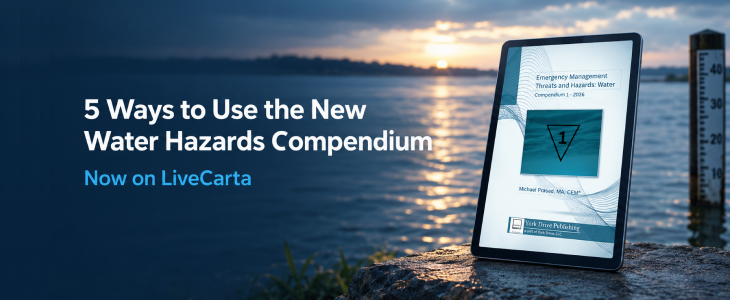
Emergency Management Threats and Hazards: Water Compendium 1 (2026), now available on LiveCarta, brings them together. Below, we look at what the compendium contains, who wrote it, and five practical ways instructors, emergency managers and students can use it.
What's inside the compendium
The compendium is a curated digital collection of web links, additional reference material and real-world stories about water-related threats and hazards. It accompanies Michael Prasad's guidebook Emergency Management Threats and Hazards: Water (Routledge/CRC Press), available in print and as an e-book.
Together, the two follow the same structure:
- Threats around water: threats from the air, the ocean, the land and other sources
- Water quality hazards: human-made contamination, natural contamination and quality impacts from other incidents
- Water quantity hazards: too little potable water and too much raw water
- Complex incidents: events that combine quality and quantity problems, such as water treatment plant failures
The guidebook explains the hazards. The compendium points you to the sources, data and case stories behind them, so you can go deeper or bring current examples into a lesson or a plan.
Explore Emergency Management Threats and Hazards: Water Compendium 1 (2026) on LiveCarta →
Written by a practitioner
Michael Prasad, MA, CEM®, is a Certified Emergency Manager with director-level experience at the State of New Jersey and the American Red Cross. He has served in leadership roles on more than 25 disaster response operations, including the response and recovery after Superstorm Sandy. Today he is a senior research analyst at Barton Dunant and executive director of the Center for Emergency Management Intelligence Research (CEMIR).
That background shows in how the material is organized. It follows the disaster phases and incident command structure that emergency managers use every day, which helps connect the classroom to the field.
1. Build a water-hazards module for your EM course
Emergency management certificate and degree programs, undergraduate and graduate, often cover water through separate units on floods, storms or public health. The compendium lets instructors treat water as one connected hazard area.
How to use it: assign the compendium alongside the guidebook as the core reading for a two- or three-week module. Use the four hazard areas as the module's weekly structure.
Takeaway: one organized source replaces a long, hard-to-maintain list of links in your syllabus.
2. Bring real-world stories into class discussion
Students remember incidents better than definitions. The compendium's real-world stories give instructors ready-made case material for discussion, group work and assignments.
How to use it: pick one incident per class. Ask students to place it in the disaster cycle (preparedness, response, recovery, mitigation) and identify which agencies and support functions were involved.
Takeaway: case-based discussion connects theory to the decisions practitioners actually make.
3. Support hazard research and grant applications
For working emergency managers, finding solid references is often the slowest part of a hazard analysis or grant application. The compendium was designed as background for exactly this kind of threat and hazard research.
How to use it: start with the relevant hazard section, then follow the linked sources for data and documented incidents you can cite.
Takeaway: less time searching, more time writing a stronger, well-referenced application.
4. Design training and exercises
Tabletop and functional exercises are more convincing when they're based on things that have really happened. Real incidents also show cascading effects, such as a flood that also compromises the water supply.
How to use it: choose a documented water incident from the compendium as the basis for an exercise scenario, then adapt it to your own jurisdiction.
Takeaway: realistic scenarios lead to more useful exercises and after-action discussions.
5. Keep a historical reference at hand
Lessons from past events shape how we plan for the next one. The compendium works as a quick reference for students writing papers and for practitioners who need historical context.
How to use it: bookmark it as a go-to starting point whenever a new water-related event makes the news, and compare it with past incidents.
Takeaway: history becomes a practical planning tool, not just background reading.
“We look forward to publishing emergency management (EM) books from York Drive Publishing on LiveCarta. Our platform let academic instructors customize courseware, which will now include EM content”— Richard Speakman, President of LiveCarta
Why it's on LiveCarta
A resource built around links and real-world examples works best in a flexible digital format. On LiveCarta:
- Instructors can customize. Combine the compendium with chapters from other titles and your own materials in one Collection.
- Students pay for what's assigned. Content is available by the chapter, so learners don't have to buy more than the course needs.
- Content stays accessible. Read in the browser or in the LiveCarta app.
The digital compendium shows how specialized, practice-driven knowledge can reach classrooms more easily. When a book is digital, modular and available by the chapter, instructors can adopt the parts that fit their course, and authors and publishers reach readers they might otherwise miss.
Are you an author, publisher or subject-matter expert in emergency management, public safety, the applied sciences or another specialized field? We'd like to hear about your work. Contact our team to talk about bringing your content to LiveCarta.
Contact us